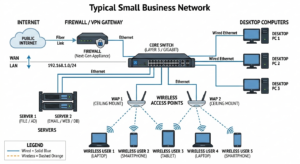
🧱 Regular Firewall vs. Next-Gen Firewall
The main difference lies in the OSI Model layers they inspect. A regular firewall usually stops at Layer 4 (Transport), while an NGFW goes all the way up to Layer 7 (Application).
| Feature | Regular (Traditional) Firewall | Next-Gen Firewall (NGFW) |
| Packet Filtering | Checks Source/Destination IP & Port. | Included. |
| Stateful Inspection | Monitors the state of active connections. | Included. |
| VPN Support | Basic Site-to-Site and Client VPN. | Advanced, often with higher throughput. |
| App Awareness | ❌ No (Sees all web traffic as “Port 443”). | ✅ Yes (Identifies Slack, Zoom, etc.). |
| Deep Packet Inspection | ❌ No (Only looks at headers). | ✅ Yes (Scans the actual data inside). |
| Intrusion Prevention | ❌ Usually a separate device. | ✅ Integrated (IPS). |
| SSL/TLS Decryption | ❌ No. | ✅ Yes (Inspects encrypted traffic). |
The Regular Firewall: Pros & Cons
Even though they are “older” tech, regular firewalls (often called Stateful Inspection Firewalls) still have their place.
Advantages
- Speed: Because they don’t look deep into the data, they have very low latency and high “wire-speed” performance.
- Cost: significantly cheaper to buy and usually don’t require expensive annual security subscriptions.
- Simplicity: Very easy to set up for basic “Block A, Allow B” scenarios.
Disadvantages
- Application Blindness: If an attack comes through a common port (like 80 or 443), a regular firewall will let it through because it can’t “see” what’s inside the traffic.
- No Malware Protection: It won’t stop a user from accidentally downloading a virus; it only cares if the connection itself is allowed.
- Easy to Bypass: Modern hackers use techniques that easily trick simple packet filters.